Feeds:
Posts
Comments

This is a page from the wine list at Veritas here in NYC. It is one of the best Wine Lists I’ve ever seen – it lists the wines along with a brief description from the Sommellier that even tells you what GRAPE is in each wine. Love. Love. Love!!!!

Stay tuned for some exciting news folks….

This might as well be me.

I may be the most financially reckless person I know. Or the most fiscally irresponsible. Regardless of how you want to say it, I am bad with money. Chalk it up to that second X gene, enabling parents, a lack of discipline, a loose character, youthful naiveté  – whatever.

I blame the economy, the recession, the City of New York and any other factor at play that abdicates me from assuming any and all responsibility for bad financial habits.

I was so thrifty last week I only spent $50 to feed myself from Sunday dinner through Friday dinner (with the exception of a quick jaunt to Momofuku Noodle on Thursday Night). That is 5 light breakfasts, 5 lunches, and 5 dinners – 15 meals on $50. That’s roughly $3.33 a meal. And yet, come Monday morning I find myself nearly destitute yet again

How is this feat possible? First off, I’d like to thank Café Gitane in the Jane Hotel for freeing me of, really, at the end of the day, a superfluous $24 that I was keeping in my bank account out of sheer curiosity– you know just to see what would happen to it if it stuck around for a while. That $24 was instead dispensed on a cocktail of iced-tea flavored water, a mound of ice, a squirt of lemon, and a splash of Jack Daniels. The extra shot they gave me to turn the whole sorry thing into some remote semblance of a cocktail cost me $10. I could have bought a pint of Jack Daniels with $10.

Next, Employees Only, you had a part to play in this whole production, too, and I’d like to see you get the recognition you deserve.  You served a beautiful Sazerac. It was gorgeous! Delicious! And $14.

Last, Cabbie that didn’t know how to get from 13th Street and 7th Avenue to the corner of Jane and Washington Streets (It’s straight by the way. You go straight.) –  thank you. Thank you for relieving me of the $9 that was burning a searing hole in my pocket, really, and don’t ever change.

So what does any of this have to do with wine? It doesn’t really. It’s merely a reminder to all of you that no matter how much more than you I know about wine, I’m still just an idiot sometimes. That being said, if I make sense out of wine and the strange world in which it resides, it should be cake for you. Instead of drowning my financial anxiety in a glass of wine tonight, I’ll be scrounging around my fridge for something to take the edge off the gin I’ve got stashed away in the back of my freezer. Because that’s the only alcoholic beverage in my apartment. Donations are welcome.


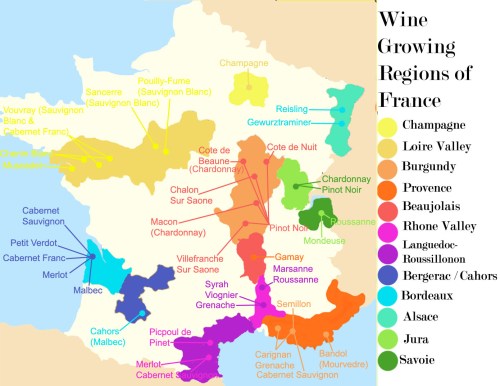
*Note: Click the map above for the full-sized image!

The French are a people who thrive on complexity. One need look no further than to their seemingly infinite varieties of spoiled dairy or to the French language and its unique affection for long strings of vowels for affirmation of this fact. These are the people who managed to take the simple combination of butter, flour, sugar, and eggs and raise it to an art form that the world devours in awestruck bliss.

The French take their wine no less seriously than they do their cheese or pastry. The country is divided into 12 wine-producing regions that are further broken down into 472 AOC’s (Appellation d’Origine Contrôlée) that are established based on geography and the unique French concept of terroir.

Though the word is derived from the French word, terre that translates to land in English, it is a concept that evokes much more than just the ground from which the wine comes. To talk about terroir is to include all of the elements of a place that were present when the grapes were growing and not just in terms of geology, geography, or weather (though those are parts of it).

Terroir encompasses everything from the plants that grew among and around the vines to the natural events that may have occurred in a single year such as a fire. Terroir is an expression of all the particular smells, textures, and conditions that surrounded the vines of a specific area at a given time. Terroir, the French insist, can account for the differences in wines that are made from grapes grown on neighboring or even adjacent hillsides.

French school children are taught their AOC’s right along with their ABC’s – that’s how important they are. As Americans, we are used to seeing the varietal on the label right alongside the place the wine’s from, but for the French, that would be redundant as each region is so clearly associated with a particular grape or blend.

Below you’ll find my attempt to make sense out of the French AOC system. Good luck and Godspeed.

• Alsace – White wines made from Reisling and Gewurtztraminer

• Beaujolais – Young wines that are made from Gamay. These wines range in style according to where they were grown within the region.

•For more on Beaujolais, check out my previous post

• Bordeaux – Big, powerhouse red wines that are composed of various blends of Merlot, Cabernet Sauvignon, Cabernet Franc, Petit Verdot, and Malbec.

• Burgundy – Pinot Noir & Chardonnay

• Côtes de Nuits, Côtes de Beaune, Côtes Chalonnaise, Maconnais

• Champagne – Perhaps it’s fitting that the wine that’s easiest to gulp down is also the easiest to remember. Champagne is made from Chardonnay grapes as well as Pinot Noir grapes that have, very early on in the process, been separated from their red skins. A minor grape called Petit Meunier, pretty much only grown for use in Champagne is also sometimes added.

• Jura – Jura is known for making Chardonnays that have been oxidized, lending them a dark amber color and flavor notes that are more similar to those found in Sherry (marzipan and orange peel). Jura also makes some fantastic sparkling wines from Chardonnay.

• Languedoc-Roussillon – For a long time the region was known for making Europe’s table wines. Lately, however, these rustic wines have gotten lots of attention for their bold and hearty style. Merlot, Cabernet Sauvignon, Grenache, Syrah, Viogier, Sauvignon Blanc, Chardonnay

• Loire – White wines made from Sauvignon Blanc and Chenin Blanc dominate the Loire Valley. These are often considered the best white wines of France.

• Sancerre & Pouilly Fume– Sauvignon Blanc

• Vouvray – Chenin Blanc

• Chinon – Cabernet Franc

• Provence – Provence is known for enchanting and delicious roses. Red wines from Provence are the best example of a wine tasting like the land its from with pronounced flavors of thyme, lavender, and black olives swimming around. The region’s red wines are a fascinating study in wine’s savory side.

• Bandol – Wines made predominantly from the Mourvedre grape that are characterized by notes of dark fruit, cinnamon, and leather.

• Rhône

• Northern Rhone – Seriously spicy and juicy wines made from Syrah-based blends that can incorporate Viognier, Marsanne, Roussanne.

• Hermitage

• Saint-Joseph

• Saint-Peray

• Southern Rhone – These wines are different from those of the north because they blend Syrah, with Grenache, Carignan, and Mourvedre.

• Right Bank – A tendency towards light and fruity

• Côtes du Vivarais

• Left Bank – Rich, intense wines that are often meant for aging

• Côtes du Rhone

• Chateauneuf du Pape

• Savoy – obscure and indigenous white grapes

• South West France – This region is mostly notable for the Malbec that is produced in Cahors. This Malbec is a big, full bodied, and highly tannic wine that is very different than Argentine Malbec. You’ve been warned.

Phew. Deep breaths. And….


JUST IN CASE all that isn’t confusing enough, the wines of each region are further broken down according to rank.

Here they are from lowest to highest quality:

Vin du Table – lowest quality wine

Vin du Pays – a step up from table wine this is the “country wine” of a specific geographic area

AOC – wine that is made according to guidelines on varietal, yield, and standards from a specific geographic area.

• Okay, this gets even more confusing because some regions also have wines that called “Villages”. In the case of Burgundy, Beaujolais, and Cotes du Rhone, a wine that is qualified as “Villages” is not really considered better than the plain old AOC wines, but qualifies as distinct enough to get its own rank-within-a-rank.

Premier Cru – Wine produced within an AOC that is considered better than most and according to certain standards but not as good as the very best.

Grand Cru – The very best wine produced in a given area that comes from specific vineyards and holds up to very strict and high standards.


While I toil away on the upcoming guide to demystifying French Wine (look for it tomorrow!) get your fix of the best of the wine news from around the web:

Often as soon as I mention to people that I write a wine blog, the first question asked is, “What’s your favorite wine?”. I hate that question. And not just because it puts me on the spot, but because, honestly, my taste for wine changes with my mood, with the weather, with what I’m eating – the variables are endless.

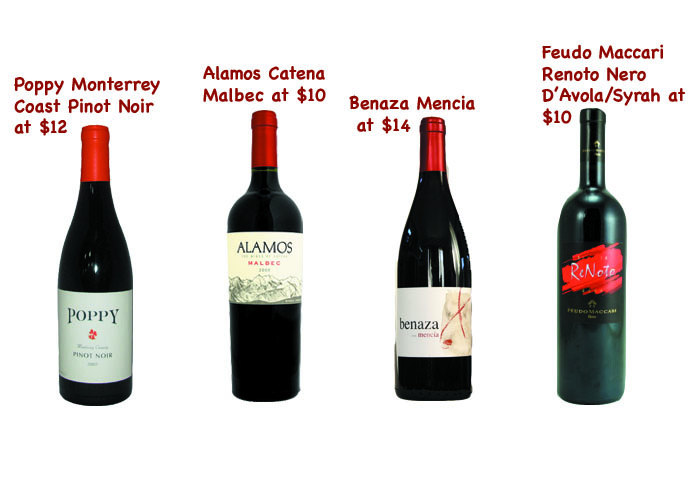
(Favorite Everyday Reds: )

However, I can say that there are wines that I return to and tend to defer to for special occasions. Generally, I’m a red drinker and generally I like wine that is far more masculine than my petite frame and girlish charms would seem to suggest. There are a few things that I look for depending on variety; I like spice in a Syrah, leather with a touch of vanilla in my Merlot, and muscle in my Priorat.

(Favorite Everyday Whites: )


I have a strange fondness for Beaujolais – a wine that lies on the complete opposite end of the spectrum as the wines I just mentioned. Beaujolais is a light wine, and it’s endlessly quaffable, but when it’s good it is sooo good and, I would argue, largely unappreciated. It can be delicate, poetic, and pretty at it its best, and the fact that it’s best served chilled doesn’t hurt it’s go-to status come summertime.

(Go-to gifting wines: )


When it comes to whites, I’m picky. I like clean, minerally and dry on one hand and floral, succulent, and crisp on the other. Pinot Noir is a tricky grape for my palate, and unfortunately I’ve found that – with a couple exceptions – I’m more inclined towards the expensive stuff as a matter of taste. I like a long lingering finish, firm structure and obscure flavors like lavender and smoke. All that being said, I’ve compiled a few short lists for my some of my favorite wines and categorized according to price. Next time someone asks me what my favorite wine is, I can simply direct them here.

PS. If you are eager to try any of the above or just want to copy me (don’t worry…it happens all the time – you’re not alone. My roommate copied my shampoo just the other week!) but you can’t find any of the specific bottles above just check out something from the same region, producer, or grape and let me know how you liked it…you can never have enough go-to’s when it comes to wine.

Me and the BF with glasses of Malbec @ Vincent Arroyo

Often times I impress people with the random pieces of information I have at my fingertips. Just as often, however, I prove infinitely annoying in my ability to remember the scientific name for the fear of beards (pogonophobia – and no, I did not just look that up) while failing to recall important things like passwords or the name of the person calling on the other line.

When the BF and I went wine tasting in Napa last summer, I managed to impress a winemaker guiding the tasting at Vincent Arroyo, a wonderful boutique winery in Calistoga, by knowing what Malbec was.

Looking back it seems that it can’t possibly have already been early June that a winemaker was impressed that a precocious 23-year-old was able to quickly identify Malbec as a typically minor grape grown in Bordeaux for blending purposes. Or that the Malbec produced in Bordeaux was typically as full bodied yet much more tannic as the juicy and smooth Malbecs coming out of Argentina.

I, on the other hand, was just as surprised to have a reason to discuss Malbec in Napa! When the wine maker produced a bottle of wine called “Bodega” for us to try and went on to tell us it was mostly a blend of Cabernet Sauvignon and Malbec with some Merlot and Cabernet Franc thrown in for good measure, it was like a revelation. Malbec? In California? Quoi???

As it turned out, the wine was delicious and if I was the kind of girl who had $35 to spend on an every-day wine, Vincent Arroyo would have made quite a profit that day.

But none of this is really the point – the point is that I can’t believe that it was June of 2010 that a winemaker was impressed with a 23-year-old knowing about Malbec.  Because these days, it often seems like the only wine people around my age know about is Malbec.

It seems nearly impossibly that it only took from early June until the middle of August for Malbec to become the wine-du-jour amongst hip 20-somethings.

The event that set the dominoes in motion, for me, was the BF’s roommate’s dinner party in LA in August. When the host (who knew less about wine than I did about an East Coast winter at the time) ordered a bottle of French Malbec, I took notice.

And then I noticed as more people around me ordered glasses of Malbec or had bottles of it open in the kitchen with more and more frequency; my cousins at family dinner, my friend Phoebe the food-blogger, one girlfriend after another on various wine nights, and on and on until, most recently, a food-loving coworker admitted she knew nothing about wine except that she knew she loved Malbec.

20-somethings and Malbec became such a thing that the very same night I was trying to convey its very thing-ness to a skeptical friend, she went back to her apartment later that night to discover a bottle of it open on the kitchen counter. She took a picture and sent it to me with a note acknowledging my acumen for wine trends…the roommates in question hadn’t opened a single bottle of wine in her presence in the six months she’d lived with them – until the Malbec.

So, you ready to be a cool kid, too? All you have to do is run out and grab a bottle of Malbec or order a glass of it the next time you see it on a wine list. Chances are, if you’re between the ages of 21-30 you’ll like the stuff. Besides the fact that its generally pretty amenable – big fruit without being overripe, nice subtle spice, and smooth – it’s also relatively friendly to the average 20-something’s budget. Go on, experience the j’nais se quoi for yourself and let me know how it goes!!!!!

Growing up, I spent 9 years at a Catholic school run by nuns of an Irish order called the Sisters of St. Louis (pronounced Loo-ee). St. Patrick’s day was as much about running around and pinching kids and teachers who dared to forget to wear green or who lazily grabbed a green marker and colored a swatch of their skin with it as it was about Sister Patricia.

Sister Patricia was our principle –hearty, stern, and mostly terrifying in only the way that a Catholic Nun can be. St. Patrick’s day also happened to be her “feast day” on which we showered her with appreciation and were, in turn, rewarded with donuts. For me, the coming of St. Patrick’s day usually brings with it a good deal of nostalgia and fond memories and so remains one of very few holidays on which I will willingly dress like I’m colorblind (ie lots of green). However, I realize that it’s a perennial favorite because it provides an excuse for carousing and binge drinking on a week night.

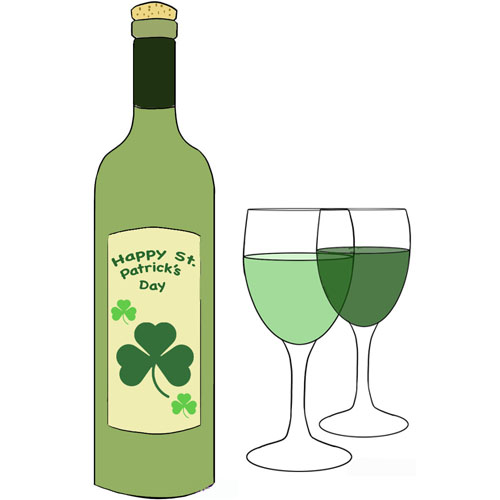
In honor of St. Patrick’s day, I have not only created the cute little graphic you see above (you’re welcome), but I have also decided to bring up the topic of Green Wine.

No, I’m not talking about getting a bottle of white wine and adding a few drops of green food coloring (although that is surely one way to go) a la the ubiquitous pitchers of green beer that will be consumed by people pretending to be Irish all across this great nation of ours (Note: I am actually, in fact, about a quarter Irish).

Instead, I’m talking about wine that has a “green” flavor profile. Though wines that are called “green” are usually being insulted, there are a few exceptions and today I’m going to tell you all about two of them.


Cabernet Franc is an interesting little grape that can count among its achievements its very famous offspring, Cabernet Sauvignon. Cabernet Franc is typically grown as a blending grape for Bordeaux-style wines but growers across the wine world have, in the past couple decades, begun to produce single-varietal Cabernet Franc wines that are often noted for their uniquely vegetal quality that can evoke green bell peppers or leaves.

Try:

Wildekrans Walker Bay 2005 (South Africa) – $14

  • In a blind taste test, it would be hard not to taste Cabernet Franc’s fingerprints all over this wine with its signature rush of wet leaves and an herbal, almost minty, nose that gives way to some easy drinkin’

Chateau de Coulaine Chinon Bonnaventure 2008 (Loire Valley) – $18

  • The Loire Valley, and specifically Chinon, has been in the game of producing Cabernet Franc based blends and single-varietals longer than anyone else, so they’ve really got the formula down. Cabernet Franc’s from this area tend to be more refined and less “green” but still have that kick of bell-pepper spice that sets this grape apart.

Shneider Vineyards Cabernet Franc La Bouchet 2005 (North Fork Long Island) – $20

  • I’ll be honest – I didn’t know that Long Island produced wine until I moved to New York and I didn’t know they produced anything other than Rose until fairly recently. The North Fork, however, makes for ideal Cabernet Franc conditions, and the wines coming out of the area are serious enough to start garnering some serious attention for New York wines.


Vinho Verde is another interesting grape, this time grown specifically in the Minho region of Portugal. While the name of the wine roughly translates to “green wine”, it’s a reference to the sprightly quality of the wine rather than to its color. These are wines that are meant to be consumed very young – and they’re fun, flirty, and can even be slightly effervescent. With flavor notes that tend to be citrusy (think lime zest) and grassy, these lovely wines are also going to cost you about just as much as a pitcher of green beer but with a higher alcohol content (9% to your typical beer’s 5%) and, chances are, a better taste. And! It’s called green wine! Win.

Try:

JM Fonseca Twin Vines 2009 – $7

  • Slightly fizzy with lots of green fruit and a splash of lime zest, this wine will wake you right up.

Famega Vinho Verde 2009 – $8

  • Very light and on the drier side, this version of Vinho Verde has a mineral tang to go along with its lime inflected flavor. Think Perrier Lime – that gets you tipsy.


*Note: Click on the image above to see it enlarged and fully-sized

The nomenclature of the wine world can be confusing. Many times the words on a wine list are hard to pronounce and totally foreign – leaving prospective drinkers grasping at any word on the page that jumps out as familiar. There are better ways to order wine than to order the one that’s easiest to say or most recognizable.

And so, I’ve decided to help you figure out what the hell you’re looking at when you’re looking at a wine list and I’ve started with Italian wines. Italian wines can be listed on a wine list according to three criteria:

1. Name of the grape that is used to produce the wine

2. Name of the region (in Italy these specific areas are called D.O.C’s – stands for Denominazione di Origine Controllata)

3. Many Italian wines are listed as Rosso di ____ . “Rosso di” roughly translates to “red wine of…” and that blank is usually filled in with the name of a nearby town or area but is not distinct enough to be a DOC all on its own or is located within a better-known DOC.

4. Sometimes, the names of the wines don’t have much to do with either and don’t worry – I’ll cover those as well.

Ok, so now that you know those basic categories, lets dive into the wines that you’re probably most likely to run into on an Italian wine list:

Italian red wines that go by their grape name

Aglianico is a grape grown mainly in Campania. It makes a rich full-bodied wine that is meant for aging

Barbera is grown in the same region as Dolcetto and shares a lot of the same qualities but its fruitier and tends to be sweeter

Cannonau (aka Grenache) is a grape that is typically grown in Sardinia

Dolcetto is the name of a grape grown in Piemonte and is usually made into a wine that’s used as a super drinkable, light, and delicious table wine. Commonly listed as:

• Dolcetto D’Alba

• Dolcetto D’Asti

• Dolcetto Di Dogliani

• Dolcetto D’Acqui


Frappato is a grape grown in Sicily and has shown up more frequently of late in single-varietal wines that are light and juicy

Montepulciano is a grape that is commonly confused with Vino Nobile di Montepulciano (named after the village in which it is produced, this wine is made with Sangiovese NOT Montepulciano). Montepulciano is grown all over Italy and specifically in Abruzzo, Le Marche, and Umbria

Pinot Nero is what the Italians call Pinot Noir (easy, right?)

Primitivo (aka Zinfandel) is a grape that is grown primarily in Puglia

Sangiovese is the grape that goes into Chianti, Brunello di Montalcino, Vino
Nobile di Montepulciano, and most Super Tuscans. However, Sangiovese can be billed on its own and often appears under its grape-name when it is produced in Emilia-Romagna or Lombardia.

Sagrantino is a grape grown mainly around the village of Montefalco in Umbria. The wine produced from this grape is a hearty rustic wine known for its earthy character and hit of cinnamon on the nose

Schiapettino is a grape grown in Friuli-Venizia and produces a medium-bodied wine with notes of raspberries, white pepper, and violets.


White wines that go by their grape names


Friulano is a grape grown in the Friuli-Veneto region .


Falanghina is a grape grown on the coast of Campania


Arneis is a grape grown in Piemonte, most commonly in the hills of Roero but also in Langhe

Muscat(o) is grown in Piemonte and is most commonly seen as Moscato d’Asti, a sweet and fizzy wine

Prosecco is the grape grow in the Friuli-Venezia region as well as the Veneto region

Trebbiano is the grape that commonly goes by the names:

• Trebbiano d’Abruzzo
• Trebbiano di Romagna
Verdicchio is a grape that is grown in Le Marche and often appears under the names:
• Verdicchio di Matelica
• Verdicchio dei Castelli di Jesi

Italian Wines that go by their growing region’s name

Valpolicella is produced from grapes grown within the Veneto region. Valpolicella is made from a blend of three varieties of grapes that are relatively obscure outside of this region and grown specifically for Valpolicella. The wine can range from light and fragrant table wines to full-bodied and big.

Chianti is produced from Sangiovese grapes grown in a specific area of Tuscany.
Chianti Classico is produced in an area that stretches between Florence to the North and Sienna to the South. These wines are usually medium-bodied, have some medium tannins, and have a lighter flavor profile of cherries and florals.
Chianti Rufina is produced in the northeastern area of Tuscany around the town of Rufina and are most widely known outside of Italy as wines with a great deal of complexity and finesse.

Rosso Orvieto is a wine produced in the Orvieto region of Umbria and is usually made up of Trebbiano-based blends for whites and Montepulciano on its own or blended for reds.

Veneto Bianco is white wine produced in the Veneto region .

Vino Nobile di Montepulciano is a wine named after the village of Montepulciano in Tuscany where it is produced. It is made from Sangiovese grapes and is a sub-style of Chianti.

Common Italian wines that go by names that have nothing to do with either their grape or where they’re grown and/or produced

Barbaresco is a wine made from the Nebbiolo grape grown in Piemonte in an area called the Langhe. Barbaresco is a big wine that requires 2 years of aging before it can even be bottled, and then is expected to age for another 5-10 years after that. Barbaresco is extremely tannic when young, but softens into a gorgeous red wine known for its floral nose, and rich earthy flavor with tendencies towards smoke, leather, and tar.


Barolo is a wine also made from the Nebbiolo grape grown in Piemont. The difference between Barbaresco and Barolo is the area in which it is grown and the fact that grapes going into Barolo are harvested after the grapes that go into Barbaresco.


Super Tuscan is a wine that is made from grapes grown in the Chianti region of Tuscany but strays from classification of Chianti because of the proportions of grapes other than Sangiovese that go into the blends. Usually, Super Tuscans, incorporate more Cabernet Sauvignon and Merlot, into their blends to produce a wine that is richer than Chianti.


Brunello di Montalcino is a red wine made from Sangiovese grapes grown around the village of Montalcino. Brunello di Montalcino is a wine renowned for its full body, smooth tannins, and bright berry flavors that are often complimented with notes of chocolate or leather.

  • Alright, I hate to be a braggard (no I don’t) but the WSJ totally came late to this party; read the recommendations for alta-wine I made months ago here [WSJ]
  • The big love being lavished on a terrifically big wine, Priorat, is well-deserved and a long time coming [WSJ]
  • For those of us who have a tendency to shatter glass rather easily, these wine glasses, should come as a Godsend (and money saver!) [Daily Meal]
  • I’m running out to find my own bottle of this Spanish gem – sounds like its right up my alley and I love discovering something new….looks like this stuff’s about to hit the big time [Daily Meal]
  • For those of you who prefer white wine and are looking for something off the beaten track check out Pinot Bianco [Daily Meal]
  • A less-than-glowing review of 2009’s Roses from Provence – worth a read if you want to know what to avoid this Spring [Huff Po]
  • Yay for lady wine-o’s….profile of a young Kiwi-ess with a knack for good wine [Daily Meal]

A note on Italy

When my friend and current roommate Jenna and I were looking for our first apartment in New York, one of the criteria we noted for every apartment we looked at was its proximity to a decent-looking wine shop. Given that there is an alarmingly high abundance of wine shops in this city (seriously, I couldn’t even begin to understand how they all stay in business), we should have known better than to thrill every time we found our potential apartment sharing a corner with a liquor store.

Another factor under consideration during our apartment hunt was location – though on this small matter Jenna and I largely disagreed. Jenna was content to settle in uptown while I was rather stubbornly intent on finding a place somewhere south of 42nd street…until the only place our broker could find in our price range was in Times Square. To a resounding chorus of “aw, hell no!” (like in a rap voice) we shuffled into our broker’s air conditioned car and headed uptown without even looking at the place and I left all downtownly ambitions behind.

We ended up in on the 2nd Floor of an old tenement building on W. 88th squarely on the Upper West Side – a neighborhood I neither knew anything about nor had ever had any inclination to explore. As it turns it out, my neighborhood is great – especially for a wine geek. Due to its, ahem, more mature population (read: parents, parents of parents, and people about to become parents) there is an abundance of great wine bars all within easy walking distance from my apartment (score!) and each with a different focus and approach to their wine lists.

A couple of weeks ago, Jenna and I left the apartment to have a glass of wine for a change, and walked a mere block and a half north to Accademia Di Vino, which specializes Italian wines. Their wines-by-the-glass list was two pages long each for both reds and whites and offered something for every kind of wine drinker and from every major region. Our bartender was friendly (not to mention cute!) and gave each of us two different wines to try before we ordered – which meant that we both got to try four.

I was pondering whether to order a Sicilian wine that was a blend of Nero D’Avola and Syrah grapes or a single-varietal single-vineyard Montepulciano that was listed under the guise of a Rosso Conero from Le Marche, a region that occupies the eastern coast of central Italy.

Jenna, on the other hand, was torn between a Rosso di Montalcino, a single-varietal Sangiovese from Tuscany and a Barbera (made from the grape of the same name and always from Piemonte). As we tasted, Jenna asked what the difference was between the Sangiovese she had tried and a Chianti listed below it that also piqued her interest.

When I told her that they were actually both made from the same grape, but in different regions and in different styles, she, exasperated, asked why they had to make it so confusing!

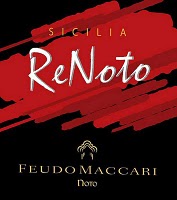
In the end, I settled into a glass of the Sicillian wine, called ReNoto, in favor of the Rosso Conero. I was in the mood for a big challenging glass of wine and the latter was a bit of a fruit-bomb and too easy for me in that moment. Jenna however, found the Barbera too sweet and the Rosso di Montalcino not quite as delicious as the Rosso Conero I’d asked to try, so she ordered up a big glass of it.

While we were happily sipping and chatting we didn’t care what the red stuff in our glasses was called.  Knowing, however, that the second wine she almost tried was made from the same grape as that of the first wine she didn’t like, though the wine list made no mention of it, steered her away from another bad choice.

This story introduces a new project that I want to include you all in! The nomenclature of wine is hard enough (what with all those foreign pronunciations) without even beginning to broach the subject of the naming systems employed by various wine-producing countries. That said, I’m going to do my very best to elucidate the whole thing according to country in the coming days. Just knowing what something is called can help you sort this whole mess out a little better and perhaps even impress a cute bartender some day (*wink*).

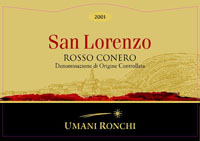
Rosso Conero, San Lorenzo, Umani Ronchi, Marche 2006

Grape: Montepuliano

Region: Le Marche

Tastes like: The fresh and juicy flavor of wild cherries with a tinge of earthy wood notes       and an herbal quality that the menu listed as “liquorice” which made my roommate turn     her nose up at it at first.

Rosso di Sicilia, ReNoto, Feudo Maccari, Sicilia 2006

Grape: Syrah and Nero D’Avola

Region: Sicily

Tastes like: Rich, spicy, full bodied, with lots of ripe fruit without being fruity, a touch of smoke and a strangely savory note of  bacon that makes this wine deelish

Rosso di Montalcino, La Fortuna, Toscana 2007

Grape: Sangiovese

Region: Tuscany

Tastes like: On the verge of fruit-bomb but with big spice, bright acid, and a dry finish

Barbera d’Alba, Bussia, Giacosa Fratelli, Piemonte 2007

Grape: Barbera

Region: Piemonte

Tastes like: Medium-bodied and on the sweet side with predominant flavors of ripe strawberries, a streak of vanilla, and a soft but dry finish